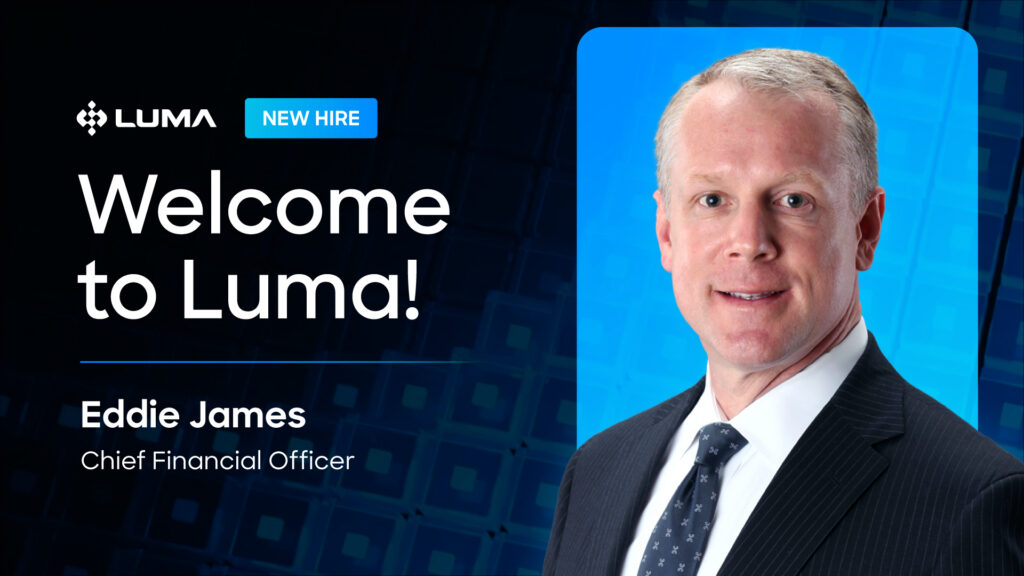
Can you tell us about your background and what led you to Luma?
I’ve spent my first sixteen years in operations and finance at UPS and Carter’s, often sitting in the room for major transactions before I was the one signing off. By the time I took my first CFO seat, I’d already done most of the job. Since then, I’ve built financial and operational infrastructure for companies at major inflection points, including Epiq Global, Inhabit, and Jitterbit. I’m drawn to transformations, hyper-growth, and transaction preparedness. These companies are often at a point where their existing infrastructure and processes are ready to be scaled up. I thrive in dynamic environments and love helping teams leverage that experience. That pattern is what led me to Luma.
What’s your finance philosophy?
Early in my career, I wanted to optimize everything at once; now I know the most important foundation to elevate is trust—in the numbers, the team, and the plan. Finance is a servant to the organization, providing insight, advocacy, and enablement predictably. I’m also passionate about where finance is headed with AI: the chance to close books faster, catch problems in real-time, and free people up for analytical work. Be a servant to the organization, build trust, and use technology to maintain it. That’s my philosophy.
Why did you join Luma?
It comes down to the industry, the stage the company is at, and the people. I was impressed by the consistent theme in my discussions with the team and board: Luma’s mission and the clarity of its goals. Luma has real momentum in a differentiated niche, and it’s at the point where platforms and systems are ready to scale seamlessly alongside rapid growth. That’s the work I find most interesting, and Luma’s AI-forward thinking drew me here too.
How do you partner for impact?
My role depends on partnership to effect change. I spend a lot of time listening intently to the team and learning about the overall organization’s needs. Then, I make sure to be transparent about my observations before proposing strategic evolutions. Being clear about the vision and the “why” behind any suggestion fosters alignment. True impact comes from finance, data, and operations agreeing on priorities together, which only happens once people trust you’ve actually listened.
Looking ahead: what are your plans for growth and impact?
Near-term, I’m excited to build upon our strong fundamentals: accelerating reporting and ensuring our systems are deeply integrated to support scale. Longer-term, I want to build a finance function that runs on real-time data and AI-assisted judgment, providing insights that allow the team to be proactive. Outside of work, I live in Knoxville with my wife. Our oldest son just had my first grandchild, our middle son is deep into AI development after graduating from The Citadel, and our youngest just started middle school. I also sit on the board of an architecture firm in Atlanta and play golf when there’s time. Twenty-five years into this, I know what I’m good at and what I enjoy. Luma is the first time in a while those two things have lined up this cleanly.